
Back to Newsroom
Microplastics in Drinking Water: A Scientist’s Guide For Your Home
February 11, 2025

Eric Roy, PhD | Chief Scientist
When people hear "microplastics," they picture ocean pollution or beach litter. For your drinking water, it is a contaminant problem and ironically, the bottled water many people drink to feel safer is one of the highest-microplastic sources there is.
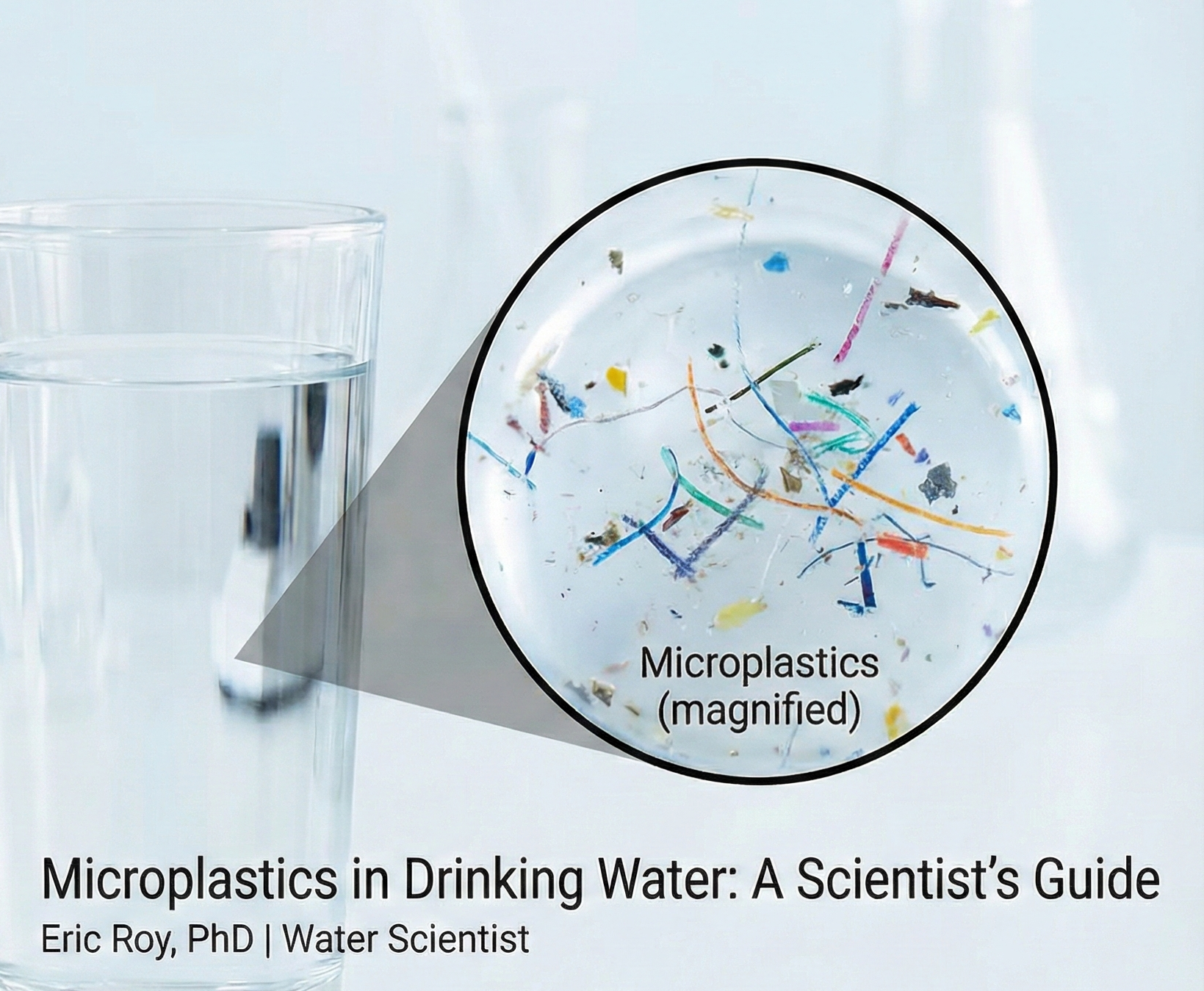
"Microplastics" technically means plastic pieces smaller than 5 millimeters, but the ones that people talk about in drinking water are much smaller (microscopic). There are microplastics you would need a microscope to see, and a new category called nanoplastics that are smaller than a micron, are harder to measure, and may be able to cross biological barriers.
The people working hardest to avoid contaminants in their drinking water often take in the most microplastics, because numerous studies show that bottled water has far more microplastics than tap water. Bottles shed particles as they are manufactured, shaken in transport, and opened. Filtered tap water kept in glass or stainless steel is usually the better choice, not to mention far cheaper and gentler on the environment.
We know microplastics get into the human body and accumulate in blood, lung tissue, and even placentas. The scientific and medical communities are working hard to better understand what this means for health. The evidence is early, but it keeps moving in one direction: the more researchers look, the more they find, and the picture has been getting worse rather than better. That is the reason why I recommend taking steps to minimize your exposure.
Look for NSF/ANSI Standard 401 with a microplastics reduction claim. To earn it, a filter has to prove it reduces particles in the 0.5 to 1 micron range, the size microplastics fall into, by at least 85 percent, so it is a tested number rather than marketing language. NSF, WQA, and IAPMO can issue this certification. If a product does not carry that certification, specifically for microplastics, do not assume it does anything about microplastics.
Does boiling get rid of microplastics? No. It does nothing to plastic particles.
Is bottled water safer? It's usually worse. Studies repeatedly find more microplastics in bottled water than in tap.
Can microplastics come from my own plumbing? Yes. Some plastic pipes, fittings, and faucet parts shed particles, which is why point-of-use filtration matters.
Do refrigerator filters handle microplastics? Only if they carry the NSF/ANSI Standard 401 claims for microplastic reduction.